

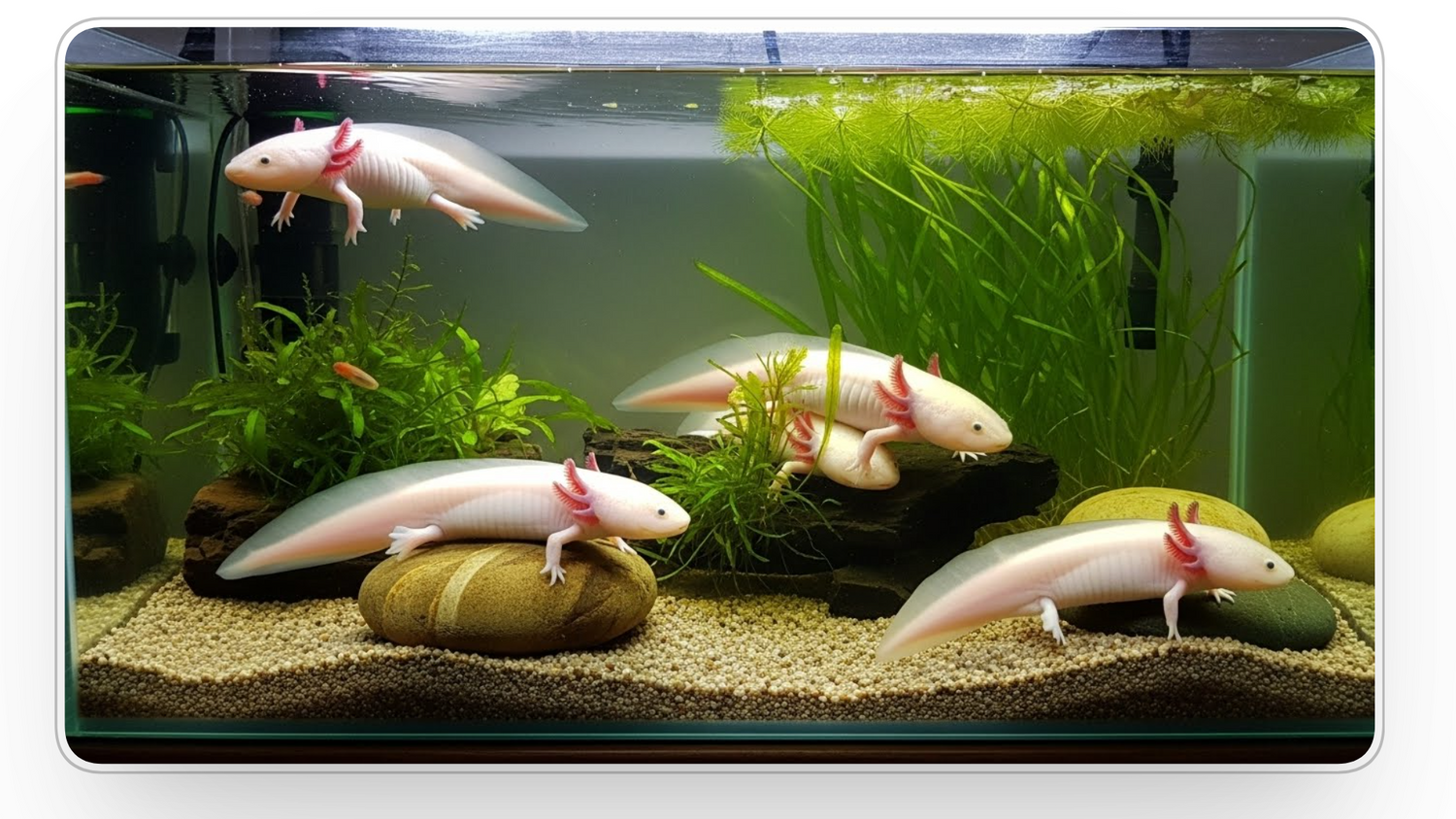
If you’ve fallen in love with axolotls online, it’s easy to focus on colors and morphs and forget the most important part: the tank. Most axolotl problems start with a bad setup, wrong size, wrong temperature, or an uncycled tank. That’s why getting the environment right from the beginning matters more than almost anything else you’ll buy for your new pet.
This complete guide walks you through how to set up an axolotl tank properly, step by step. You’ll learn the right tank size, ideal temperature, filtration, and substrate, how to cycle your tank before adding an axolotl, what decor is safe (and what to avoid), and basic maintenance so the tank stays stable long-term. Set this up first, and your axolotl will have a much better chance at a long, healthy life.
Here are things that you need to look carefully for tank setup.
1. Choosing the Right Tank Size

How Big Should an Axolotl Tank Be?
For a single adult axolotl, a 20-gallon tank is generally the minimum recommended size, but larger tanks such as 30 or 40 gallons are even better. Extra water volume gives your axolotl more room to move and explore, helps keep water parameters more stable, and makes it easier to manage waste and temperature swings. A long tank is usually better than a tall one, since axolotls spend most of their time near the bottom and use floor space much more than height.
Can You Keep More Than One Axolotl Together?
Many keepers and guides suggest one axolotl per tank, especially for beginners, because cohabitation always carries a risk of biting and stress. If you ever consider more than one:
- The tank must be significantly larger than 20 gallons
- Axolotls must be similar in size to reduce bullying and nipping
- You still need to watch for injuries and be ready to separate them
Even in big tanks, there is no guarantee they won’t bite each other, so think of cohabitation as advanced, not standard.
2. Ideal Water Temperature and Cooling

Best Temperature Range
Axolotls are cold-water animals, and most care guides suggest keeping the water around 60–68°F (15–20°C). Short spikes above this range are stressful and should be brought down quickly, and water that stays warm for long periods can lead to ongoing stress, more frequent infections, and a shorter lifespan.
How to Keep the Tank Cool
Depending on your climate and home:
- Use fans blowing across the water surface to increase evaporation and cool the tank
- Float frozen water bottles as a short-term fix in hot weather (watch for sudden swings)
- Keep the tank in a cooler room, away from windows, heaters, or electronics
- Use an aquarium chiller if your home is regularly too warm for comfort
Avoid heaters unless you live somewhere extremely cold and your water is dropping below safe limits; most axolotl owners never need one.
3. Filtration and Water Flow

What Kind of Filter Do Axolotls Need?
Axolotls produce a lot of waste, so they need good biological filtration, but they dislike strong flow. Good filter options include:
- Sponge filters powered by an air pump
- Canister filters or hang-on-back filters with adjustable or baffled flow
Choose a filter rated for at least your tank size, and ideally one step up, to handle waste better.
Managing Water Flow
Axolotls are not strong swimmers and don’t enjoy being blasted around the tank. To keep flow gentle:
- Aim the filter output at the glass or use a spray bar
- Add a sponge pre-filter on the intake to soften flow and protect gills
- Watch your axolotl: if it’s constantly pushed around or hiding from the current, the flow is too strong
Calm water with good filtration is the goal.
4. Substrate: Bare Bottom vs Sand vs Gravel

Best Substrate Options
You have two main safe choices for an axolotl tank floor: bare bottom or fine sand. A bare bottom tank is very easy to clean because waste has nowhere to hide, and there is no risk of your axolotl swallowing substrate. This makes it a great option for beginners and juveniles or for anyone who wants simple, low-maintenance cleaning.
Fine sand is another safe choice that looks more natural and still works well with axolotl feeding habits. If small amounts are swallowed, sand usually passes through the gut without causing a problem. It does, however, need gentle vacuuming to remove waste without stirring up big clouds, so it suits keepers who are comfortable with a slightly more involved cleaning routine.
5. Safe Decor, Plants and Hides

Choosing Safe Decor
Axolotls like places to hide and feel secure, but decor must be chosen carefully.
Good options include:
- Smooth caves or ceramic hides without sharp edges
- PVC pipes cut and sanded smooth
- Large, smooth rocks that are too big to swallow
Avoid:
- Rough, jagged rocks or driftwood that can tear gills or skin
- Fake plants with hard, sharp plastic leaves
- Decor with small holes or tight gaps that can trap limbs or gills
If you can run a stocking or soft cloth over it without snagging, it’s usually safe.
Live vs Fake Plants
Both can work if chosen wisely:
Live Plants:
- Choose cool-water tolerant species
- Help absorb some nitrates
- Need light and may not love very cold tanks
Fake Plants:
- Soft silk plants are safer than hard plastic
- Easier for beginners and low-light setups
- Always prioritize your axolotl’s safety over aesthetics.
6. Water Parameters and Testing

Key Water Parameters for Axolotls
Stable, clean water matters more than fancy gear. For axolotls, you want:
- Ammonia: 0 ppm
- Nitrite: 0 ppm
- Nitrate: as low as practical, often under ~40 ppm, lower is better
- pH: generally stable between about 6.5–8.0, with no sudden swings
If ammonia or nitrite are above zero, your axolotl is at risk and you need to take action.
Testing Your Water
Use a liquid test kit instead of strips, because it’s more accurate and cost-effective long term. Test:
- Weekly in stable, mature tanks
- More often when cycling, after big changes, or if your axolotl looks stressed
Testing is the only way to know what’s really happening in the water.
You can also read Fantaxies’ guide, How to Set Up an Axolotl Tank: 8 Steps, and use it alongside this article when you plan your own axolotl’s home.
7. Cycling Your Axolotl Tank

What Is Cycling?
Cycling is the process of building up beneficial bacteria in your filter and substrate so they can convert toxic waste into less harmful forms. In simple terms:
- Ammonia from waste and food is converted to nitrite
- Nitrite is then converted to nitrate
- Nitrate is controlled through water changes and plants
An uncycled tank can quickly build up ammonia and nitrite, which burn gills and can kill an axolotl.
How to Cycle Before Adding an Axolotl
A basic fishless cycle usually goes like this:
- Set up the tank with filter, substrate, and decor, then add water and conditioner
- Add an ammonia source (pure ammonia or fish food) to feed the bacteria
- Run the filter 24/7 and test the water regularly
- Wait until you see ammonia go up, then nitrite, then both drop to 0 while nitrates rise
Cycling can take several weeks, sometimes longer. Do not add an axolotl until:
- Ammonia: 0 ppm
- Nitrite: 0 ppm
- Nitrate: measurable and not zero
Patience here prevents most beginner disasters.
8. Lighting and Tank Placement

Do Axolotls Need Lights?
Axolotls do not need bright lights and often prefer dim or shaded conditions. You can:
- Skip strong lights completely if you don’t keep light-demanding plants
- Use a soft, low-intensity light on a timer for viewing
- Provide plenty of hides so your axolotl can avoid the light if it wants to
Strong, direct lighting can stress them, so keep things gentle.
Where to Put the Tank
Placement makes a big difference:
- Keep the tank away from direct sunlight, which can overheat the water and cause algae
- Avoid placing it near heaters, radiators, or hot electronics
- Use a secure lid or cover to prevent jumps and keep other pets or children out
A cool, quiet corner of a room often works best.
9. Basic Axolotl Tank Setup Checklist
Before you bring an axolotl home, you should already have:
- A 20+ gallon tank (larger if possible)
- A gentle filter, installed and running
- A cooling plan (fans, cool room, or chiller if needed)
- A liquid water test kit and water conditioner
- Bare bottom or fine sand substrate
- Safe hides and simple decor
- The tank fully cycled with stable 0 ammonia and 0 nitrite
Once all of this is ready and stable, then it’s time to think about choosing your axolotl.
Common Axolotl Tank Setup Mistakes to Avoid
Some of the most common and serious mistakes include:
- Using gravel or small stones as substrate
- Adding an axolotl to an uncycled tank
- Keeping the tank too warm or in direct sunlight
- Using very strong filters without reducing flow
- Treating axolotls like tropical fish and following fish-only advice
Avoiding these early mistakes will save you a lot of money, stress, and vet visits.
How Much Does an Axolotl Tank Setup Cost?
Exact costs vary by where you live and what you buy new versus used, but in general the tank and stand are a moderate one-time cost, especially if you can find a used setup in good condition. The filter, test kit, water conditioner, and basic decor add another modest to moderate layer of expense, while cooling (from simple fans to a full chiller) can range from very inexpensive to a more serious investment in hot climates. Very often, the setup costs more than the axolotl itself, which is normal for a long-lived aquatic pet, so planning your budget around the tank first is the best way to avoid surprises.
FAQS
1. What is the minimum tank size for an axolotl?
Most keepers recommend at least 20 gallons for one adult axolotl, with larger tanks offering more stable water and extra room. A long tank is better than a tall one because axolotls use floor space more than height.
2. Can I use a fish tank I already own for an axolotl?
Yes, as long as it meets the size and safety needs: cool enough water, a gentle filter, safe substrate, and no sharp decor. You’ll also need to fully cycle it before adding the axolotl, even if it was used for fish before.
3. How long does it take to cycle an axolotl tank?
Cycling usually takes several weeks, often around 4–8 weeks depending on temperature, bacteria sources, and how you feed the cycle. The tank is ready when ammonia and nitrite both read 0 ppm and nitrates are present.
4. Do axolotls need a heater?
In most homes, no. Axolotls usually need help staying cool, not warm. A heater is only useful if your water is dropping below safe cool-water ranges and you live in a very cold environment.
5. Can axolotls live with fish or other tank mates?
Most care guides suggest keeping axolotls alone, because fish can nip their gills or be eaten, and other tank mates can carry diseases. If you ever try tank mates, it should be done very carefully and is not recommended for beginners.
6. How often should I clean an axolotl tank?
You should spot-clean waste as needed and do regular partial water changes, often around 20–30% weekly in a properly filtered tank. Clean the filter on a schedule that keeps flow steady without destroying the beneficial bacteria.

Leave a comment
This site is protected by hCaptcha and the hCaptcha Privacy Policy and Terms of Service apply.