

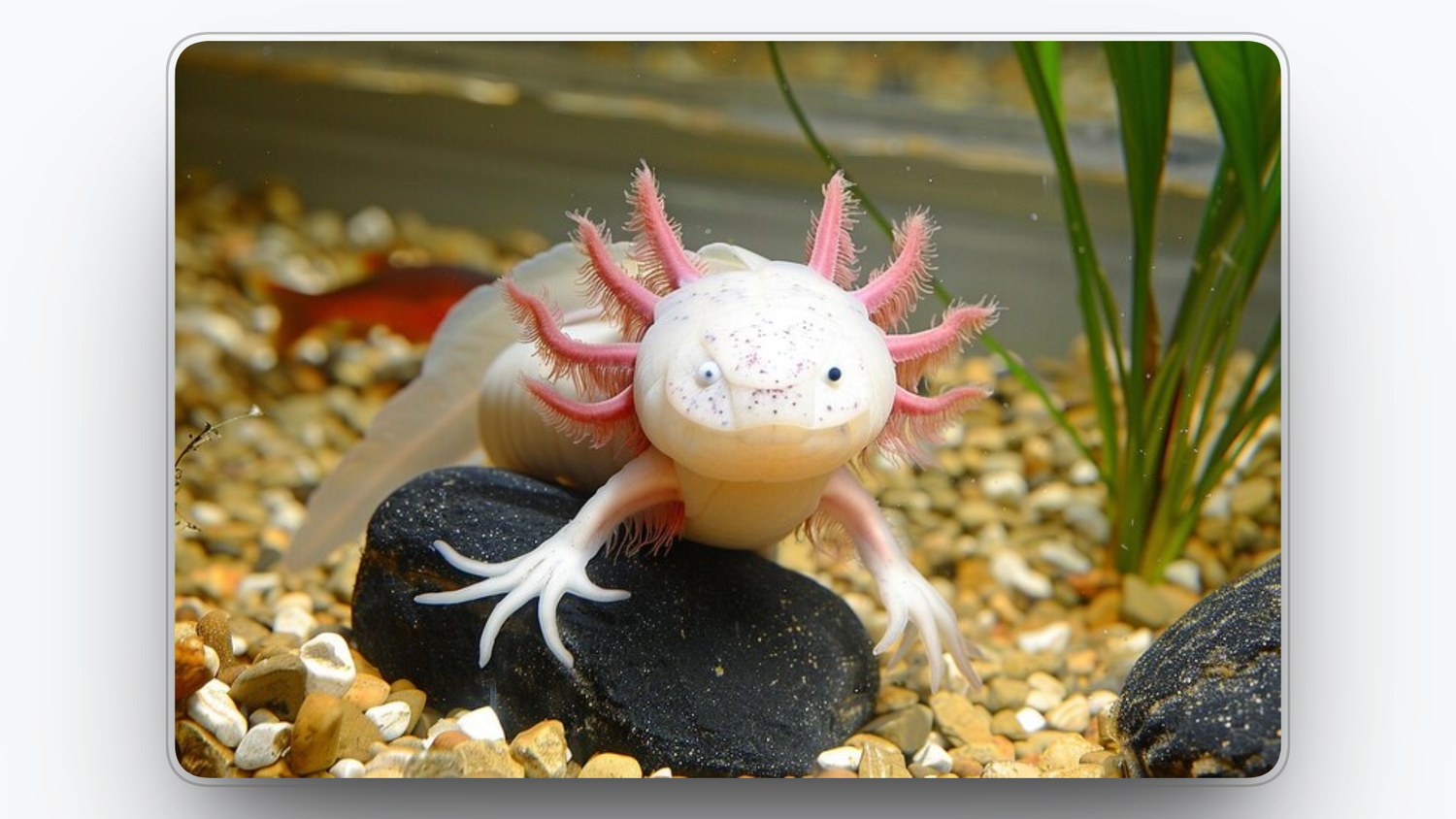
The axolotl is a salamander that stays in water for all life. It keeps gills on the sides of the head and breathes through them. Axolotls in nature live in lakes near Mexico City, and axolotl pets now come from breeding in tanks.
An axolotl pet grows to around 30 cm and can live 10 to 15 years. For axolotl care, use a tank with water at 16 to 18 °C, a filter, a lid, and room for the animal to move. The axolotl rests on the bottom and then hunts food in bursts.
This guide covers axolotl tank setup, day-to-day axolotl care, and the most common mistakes to avoid so your axolotl stays healthy for years.
Basic Axolotl Facts
Axolotls are long-term, low-drama pets. With cool, clean water and good axolotl care, many live 10–15 years and grow to about 9–12 inches (23–30 cm) as adults. They come from the canal system of Lake Xochimilco in Mexico City, where the water is cool, slow, and shaded. In a home tank they are calm, bottom-dwelling animals that spend most of the day resting, then burst into action when food appears. One of the things that makes them so unique is their regeneration: axolotls can regrow lost limbs, gills, and even parts of organs, which makes them fascinating to watch and care for.
Cost & Where to Buy an Axolotl
One-Time Setup Cost
Set a clear budget before you start. For one axolotl tank setup, plan for a total in the range of $400–$800.
- Tank (29–40 gallons): $50 – $150
- Filtration (sponge or canister): $40 – $150
- Freshwater master test kit: $35 – $50
-
Cooling options:
Clip-on fans: $20 – $40
Aquarium chiller: $300 – $600 - Substrate (fine sand) and decor: $50 – $100
- Dechlorinator: About $15
Ongoing Monthly Cost
After the setup, axolotl care brings steady running costs each month.
- Food (worms or pellets): $10 – $20 per month
- Water conditioner and electricity: $5 – $15 per month
- Total ongoing cost: About $25 per month
Where to Buy an Axolotl (Breeders, Stores, Online, Rescues)
Avoid buying axolotls from general “big box” pet stores, as they are often kept on gravel, in warm water, or in uncycled tanks. These problems can lead to hidden health issues that only show up after you bring the animal home.
For the healthiest start, look for dedicated axolotl breeders who focus on water quality, genetics, and proper housing. A strong option is Axolotl Planet, a specialist axolotl breeder that offers different color morphs, carefully tracked breeding lines, overnight shipping with a live arrival guarantee, and support after the sale for tank setup and feeding questions. You can also search for reputable local breeders or rescues, but always ask how the axolotls are kept and what they are fed before you decide.
How to Pick a Healthy Axolotl

A healthy axolotl has gills that stand out from the head and hold their shape, with no rotting tissue or white fuzz on the filaments. The body and belly should look gently filled out, not razor-thin or sharply sunken at the sides, and all four legs should be present with full toes on each foot. The skin should look smooth and clean, with no red sores or cottony patches.
In the tank, the axolotl may rest a lot, but it should still shift position, track movement in the room, and show a clear feeding response when food is offered or when you tap lightly on the glass. The water around it should look clear and have no strong smell, and there should be no dead tank mates nearby. If several of these checks fail, it is safer to walk away and look for a healthier animal.
Is it Legal?
In the United States, axolotl legality changes from state to state, so always check before you buy. At the time of writing, axolotls are illegal to own in California, Maine, New Jersey, and Washington D.C. Some states, such as Hawaii and New Mexico, require a permit, while most other states allow axolotls as pets but may still have county or city rules. Laws can change without much warning, so it is smart to confirm current regulations with your local authorities before bringing an axolotl home.
Axolotl Tank Setup Guide
Tank Size and Lid
- For one adult axolotl, use a 29–40 gallon tank.
- Pick a tank with more length than height.
- Always use a lid.
- Mesh lid works well with fans.
- Solid lid works well with a chiller.
Bare Bottom vs. Sand vs. Tile
Bare Bottom: Safest and easiest to clean, but provides no grip for the axolotl (can cause stress).
Fine Sand: The best option for adults (over 5 inches). It mimics their natural lake bed and allows them to grip the floor.
Tile/Slate: Good grip, easy to clean, looks modern.
Why Gravel is a Risk
NEVER use gravel or small stones. Axolotls eat by suction (vacuuming water). They will accidentally inhale gravel, which causes impaction (intestinal blockage) and death.
Filter Types And Low Flow
Axolotls do not like strong water flow. Constant current can stress them and make their gills curl forward. The goal is clean water with soft, slow movement.
- Sponge filter: Runs on air, gives soft flow, and holds lots of bacteria for the cycle. Safe for axolotl feet and gills.
- Canister filter: Works well on larger tanks (40 gallons and up). Use a spray bar or other outlet that spreads the return water so it does not blast one spot.
With any filter, point the flow at the glass or decor, not at the axolotl, and adjust it until the animal can rest without fighting the current.
Hides And Decor
Axolotls have no eyelids and are sensitive to light. You must provide at least two hiding spots (caves, PVC pipes, terra cotta pots). Ensure all decor is smooth and sharp edges will tear their delicate skin.
Light Needs
Axolotls do not need aquarium lights. In fact, they prefer dim environments. If you want a light for viewing or plants, choose a dimmable LED and run it only for a few hours a day, or provide plenty of overhead cover (floating plants).
Safe Plants & Hardscape
Plants and hardscape give shade and simple cover without adding much work.
- Plants: Pick low-light, cool-water plants like Anubias, Java fern, and marimo moss balls. They can sit on rock or wood and do not need strong light.
- Hardscape: Use driftwood and smooth stones larger than the axolotl’s head so they cannot be swallowed. Place them so they do not fall and the axolotl can move around them easily.
How to Cycle an Axolotl Tank
This is the most important section of the guide. You cannot simply fill a tank with water and put an axolotl in it. The water must be "cycled."
What Is the Nitrogen Cycle?
The nitrogen cycle is a group of bacteria that live in the filter and on tank surfaces.
- Axolotl waste and old food break down into ammonia (toxic).
- One group of bacteria turns ammonia into nitrite (toxic).
- Another group of bacteria turns nitrite into nitrate (safer at low levels).
This process keeps waste in check and makes the water safe when you do regular water changes.
Fishless Cycle: Step-by-Step
- Set up: Fill tank, turn on filter, add dechlorinator.
- Add Ammonia: Add liquid ammonia (Dr. Tim’s) to reach 2ppm on your test kit.
- Wait & Test: Test daily. Ammonia will drop, and Nitrite will spike.
- Feed the Bacteria: Keep adding ammonia to keep it at 2ppm until Nitrite appears
- .The Finish Line: The tank is ready when Ammonia is 0ppm and Nitrite is 0ppm strictly 24 hours after you dose ammonia. Nitrate will be high.
- Water Change: Do a 50–70% water change to lower Nitrates, then add the axolotl.
Test Kit Use
Do not use paper strips; they are inaccurate. Use the API Freshwater Master Test Kit (liquid drops) for reliable results.
Signs the Tank Is Ready
You can add 2ppm of ammonia, and 24 hours later, the test reads:
- Ammonia: 0ppm
- Nitrite: 0ppm
- Nitrate: <20ppm (after water change).
Axolotl Water & Temperature Care

Ideal water parameters
Axolotl care depends on clean water with the right range of values:
- Ammonia: 0 ppm. Any reading above 0 can burn gills and skin.
- Nitrite: 0 ppm. Like ammonia, even small amounts are not safe.
- Nitrate: 5–20 ppm. If it rises above 20 ppm, do a water change.
- pH: stay between 6.5 and 8.0 and keep it stable, not jumping up and down.
- Hardness: mid to hard water (around GH 7–14) helps keep pH steady and supports the body.
Ideal temperature range
Axolotls are cold-water animals and feel best in cooler tanks:
- Main range: 60–64°F (16–18°C).
- Wider safe range: 58–68°F (14–20°C).
- Danger zone: 70°F (21°C) and above. Warm water raises stress, lowers oxygen, and can lead to fungus and death if it stays high.
Keeping both water values and temperature in these bands makes axolotl care much easier in the long run.
Cooling Options
- Clip-on Fans: Uses evaporation to cool water by 3–5 degrees. Requires topping off water frequently.
- Aquarium Chiller: The most reliable method. Set the temp to 64°F and forget it. Expensive but worth it for hot climates.
- Frozen Bottles: Emergency use only. It causes temperature fluctuations which can stress the animal.
Maintenance Routine
- Weekly: Test water with a kit. Change 20–30% of the water. Vacuum waste from the sand.
- Daily: "Spot clean" (turkey baster) any poop immediately to keep ammonia low.
Axolotl Food & Feeding
Axolotls are meat eaters. In a home tank they do best on simple, steady foods that sink. A good axolotl diet keeps growth steady, keeps waste under control, and is easy to repeat.
Best foods
- Earthworms (nightcrawlers or red wigglers)
- Sinking pellets made for axolotls or carnivore fish
- Blackworms or chopped bloodworms for young axolotls
- Occasional treats like brine shrimp or bloodworms for adults
Avoid foods like beef, chicken, and feeder fish. They add fat, can carry disease, and do not match what an axolotl needs.
Feeding schedule
- Young axolotls: small meals once each day
- Adult axolotls: normal meals every 2–3 days
Feed what the axolotl can eat in a few bites. If food sits on the floor, offer a bit less next time.
How to feed and clean up
- Use tongs to place food near the axolotl’s head.
- Let the axolotl grab the food with a quick suck.
- Remove uneaten food after 10–15 minutes.
- Do not leave loose food in the tank between feeds.
This keeps the axolotl well fed and stops old food from breaking down and polluting the water.
If you want a deeper breakdown of food choices, portions, and feeding by age, you can follow our complete axolotl diet checklist as a step-by-step feeding plan.
Axolotl Behavior & Stress
Axolotls show a lot through how they move and where they sit in the tank. Watching daily behavior is one of the fastest ways to spot a problem.
Normal Behavior
- Sits on the bottom or on a hide for long periods.
- Walks slowly across the tank floor now and then.
- Snaps at food with a quick suck and then settles again.
- Sometimes it goes to the surface for a small gulp of air.
- Moves away if light is strong, but comes out again when it is dim.
Signs of Stress
- Gills curl forward and stay that way.
- The tail tip bends into a clear hook.
- Axolotl swims fast along the glass as if trying to escape.
- Floats for long periods or struggles to sink.
- Stays hidden all the time and ignores food.
How to Calm an Axolotl
If your axolotl is stressed, test the water immediately. If parameters are fine, check the flow (turn it down) and turn off the lights. A tea bath (using 100% black tea, no additives) can soothe their skin and slime coat.
For situations where your axolotl is not just stressed but actually sick and needs treatment, it also helps to know which products are safe. You can use this guide from Fantaxies, 28 Axolotl Safe Medications & Treatments: The Complete List, as a reference when you are working with your vet or choosing medications.
Axolotl Tank Mates

Axolotls do best in tanks made just for them. Other animals in the same tank can cause stress, injury, or hard-to-fix health problems.
One Axolotl vs. Multiple
- One axolotl in one tank is the best plan for new keepers.
- Axolotls do not need friends and do not feel lonely in a tank.
If you keep more than one axolotl
- Keep axolotls that are close in size so one does not bite or eat the other.
- Keep males and females apart if you do not plan to raise eggs and young.
- Add more water and floor space for each extra axolotl in the tank.
Why other animals are a risk
- Fish may bite gills or get swallowed and block the throat.
- Shrimp and other small animals may be eaten and can bring in disease.
- Snails can be swallowed and shells can block the gut.
- Turtles and similar pets can bite off limbs or cause deep wounds.
- For low risk axolotl care, keep the tank for axolotls only.
Common Axolotl Care Mistakes
- Buying an axolotl before the tank is fully cycled.
- Using gravel or small stones that the axolotl can swallow.
- Keeping an adult in a tank that is too small for its size.
- Letting the water stay warm for long periods with no cooling plan.
- Skipping regular water changes and basic tank cleaning.
- Feeding too much or using low-quality or unsafe food.
- Handling the axolotl often instead of keeping it in the water.
FAQs
Do axolotls need a heater?
No. Most homes are warm enough already. Axolotls like cool water, so a heater is only needed if the room often drops below about 55°F (12°C). In many cases you focus on cooling, not heating.
Do axolotls need a filter?
Yes. Axolotls eat meat and make a lot of waste. A filter holds the bacteria that turn this waste into safer forms and keeps the water stable between water changes.
Can axolotls live with fish?
No, it is not a safe plan. Fish can bite gills, bring in disease, or get swallowed and block the throat. For simple care, keep axolotls in a tank on their own.
Do axolotls need land?
No. Axolotls live in water for all life. Short time out of water is only for care, like moving the animal, and should be brief and gentle.
How often should I change the water?
In a cycled tank, change about 20–30% of the water once a week. This keeps nitrate down and removes waste that the filter cannot handle.
How many axolotls can fit in one tank?
Plan 1 axolotl for a 29–40 gallon tank. If you keep more than one, move up to a larger tank and make sure there is wide floor space, not just tall glass.
How long do axolotls live?
With cool water and steady care, many axolotls live 10–15 years. Think of them as a long-term pet, not a short project.


Leave a comment
This site is protected by hCaptcha and the hCaptcha Privacy Policy and Terms of Service apply.