

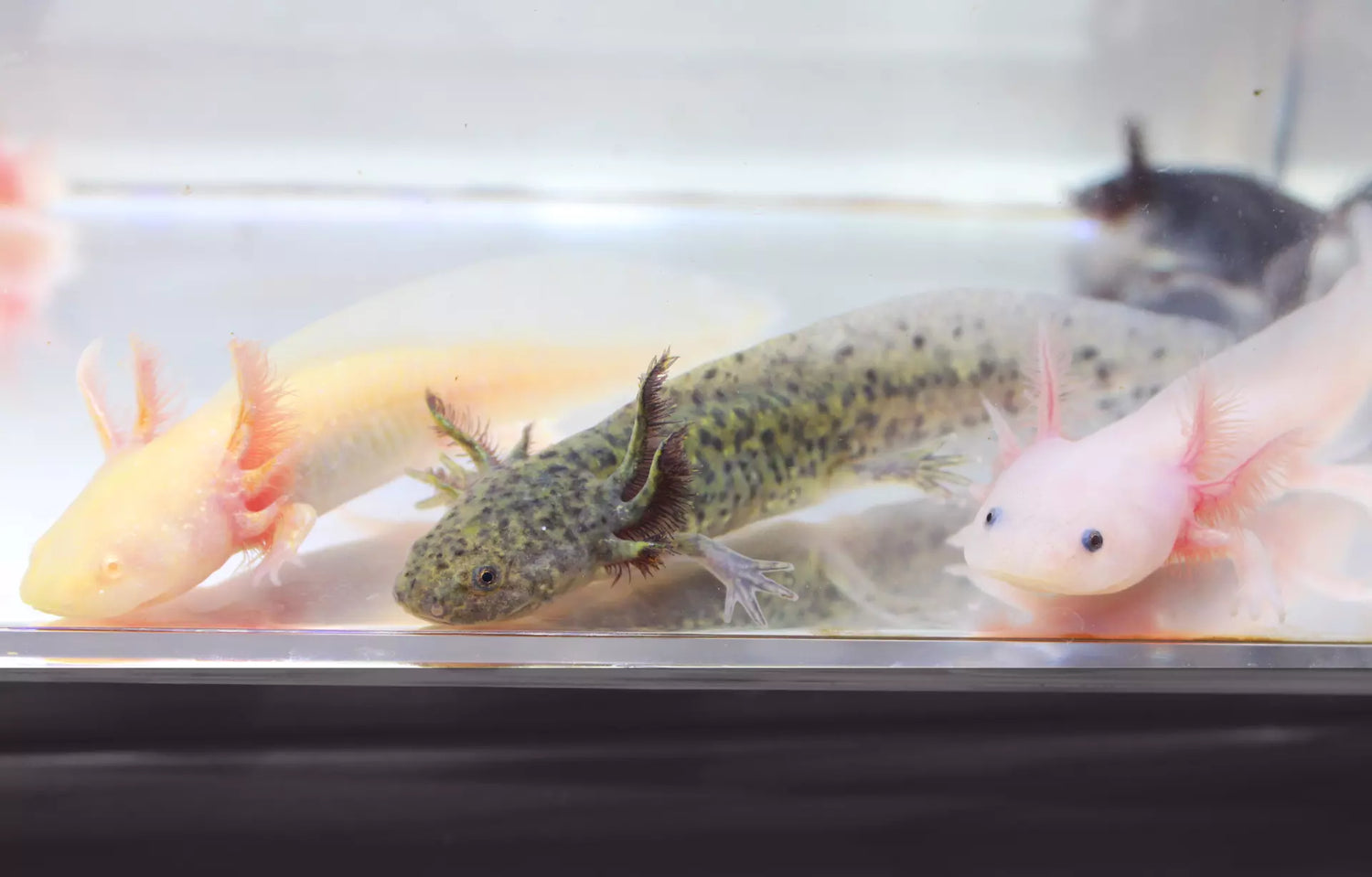
If you’ve spent any time on Axolotl TikTok or browsing pet shops, you’ve probably seen the same few faces: wild types, lucys, and golden albinos. Cute? Yes. Rare? Not really.
There’s a much smaller group of axolotls that almost never show up for sale and sometimes only exist in a few collections. Some are hard to produce, some don’t survive or breed well, and a few are basically “one-off” accidents.
In this guide, we’ll quickly walk through 10 of the rarest axolotls you’ll almost never see, what makes them special, and how realistic it is to ever own one.
Rare Axolotl Morphs Rundown
Here’s a quick look at the rarest axolotl morphs and what makes each one special.
|
1. Melanoid Axanthic Copper Axolotl (MAC)

This ultra rare axolotl morph combines melanoid, axanthic, and copper traits into a smoky lavender body. It’s widely considered one of the rarest axolotl morphs that can be selectively bred.
How Rare it Actually is
- Expresses three recessive traits at once, which is very hard to achieve reliably in breeding.
- Often sold as “among the rarest axolotls you will find” by specialist breeders.
- Usually appears in very small numbers and sells out quickly when listed.
Can You Actually Buy This Morph
Yes, but not often MACs show up mainly through high-end breeders and niche shops, and they tend to disappear fast once posted. Fantaxies has offered MAC axolotls before, but availability is limited and stock may be sold out when you look.
Things to Check Before You Buy
- Make sure you already have a cool, cycled tank ready before you even send payment.
- Check if axolotls are legal where you live, because some states and countries do not allow them at all.
- Ask for clear, close photos so you can see the smoky lavender body and darker eyes yourself.
- Confirm with the seller that this is a real MAC and not just a dark or lavender looking axolotl.
- Look for a health or live arrival guarantee because MAC axolotls are rare and usually quite expensive.
2. Hypomelanistic Axolotl

This rare axolotl morph has a soft golden or pastel body with bright red or orange gills that really pop in the tank. It looks like a “washed-out” version of darker morphs, giving it a gentle, glowing appearance.
How Rare it Actually is
- Described by multiple breeders as a newer, rare morph that isn’t yet common in the hobby.
- Line-breeding for consistent hypo traits is still limited to a small number of programs.
- Often priced higher than standard morphs because demand is growing faster than supply.
Can You Actually Buy This Morph
You can sometimes find hypomelanistic axolotls from dedicated breeders or specialty shops, but they’re not as widely listed as common morphs. Availability is usually in small batches and may come and go through the year.
What to Know First
- Have a stable, cool tank with gentle water flow and safe hiding spots ready before ordering.
- Check your local rules so you do not buy a hypomelanistic axolotl in a place where they are not allowed.
- Ask for recent photos taken in normal light so you can see the true pastel color and bright gills.
- Make sure the seller can clearly tell you it is hypomelanistic and not just a pale normal morph.
- Be ready for a higher price than common morphs because hypomelanistic axolotls are still quite rare.
3. Hypomelanistic Melanoid Axolotl

This extremely rare axolotl morph mixes reduced dark pigment with the melanoid trait, creating a smooth grey-purple or charcoal look. It often appears like a softer, ghostly version of a solid black melanoid.
How Rare it Actually is
- Often described as “extremely rare” with very few confirmed lines worldwide.
- Requires stacking hypomelanism on top of melanoid genetics, which takes careful, multi-generation planning.
- Sold in very low numbers, frequently at premium prices in the hundreds of dollars.
Can You Actually Buy This Morph
Yes, but only from a handful of serious breeders and specialty shops when they have them available. Fantaxies has specifically listed Hypomelanistic Melanoid Axolotls in their “Rare” category, but they’re often marked sold out.
Things to Check Before You Buy
- Set up a cool, fully cycled tank with low light since this morph is usually very dark and shy.
- Check if keeping axolotls is legal in your area before you start looking at rare morphs.
- Ask if the parents were hypomelanistic and melanoid so you know the genetics are real.
- Expect a waiting list or very limited stock because this is one of the harder morphs to find.
- Talk with the seller about shipping and how to acclimate the axolotl gently when it arrives at your home.
4. Axanthic Copper Axolotl

This rare axolotl morph shows a cool grey or silver base warmed up with soft copper tones along the body and head. The overall effect is a muted lavender-grey axolotl that looks very different from bright pet-shop colors.
How Rare it Actually is
- Combines two recessive traits (axanthic and copper), so not every pairing produces visible axanthic coppers.
- Far less common than single-gene axanthic or copper axolotls on sales sites.
Usually listed in small numbers and often tagged as rare or limited.
Can You Actually Buy This Morph
Yes, axanthic copper axolotls do appear from time to time on marketplaces and with specialist breeders. Fantaxies has an Axanthic Copper Axolotl product, but like many rare morphs, stock can be sold out between breeding seasons.
Things to Check Before You Buy
- Make sure your tank is cool, cycled, and big enough, as rare morphs still need perfect basic care.
- Check local laws so you do not order an axolotl into a state or region where they are banned.
- Ask the seller to confirm it is axanthic copper, not just copper or just axanthic, and request clear photos.
- Look for a seller who explains the morph in simple words and does not hide behind fancy names only.
- Be ready to act fast when one is listed because axanthic copper axolotls usually sell out quickly.
5. Copper Melanoid Axolotl

Copper melanoid axolotls have a rich dark-copper or chocolate body with velvety, low-shine skin and fluffy gills. In good lighting, they look like a deep metallic bronze version of the classic melanoid.
How Rare it Actually is
- Considered “among some of the rarest morphs to come across” by specialist shops.
- Needs both copper and melanoid genetics to line up, which limits how many appear in each clutch.
- Often categorized as a rare or premium morph with higher pricing than standard colors.
Can You Actually Buy This Morph
Yes this is one of the rare axolotl morphs you can realistically find if you’re patient. Fantaxies and other niche axolotl stores list Copper Melanoid Axolotls when available, though they may be sold out at any given moment.
Things to Check Before You Buy
- Prepare a cool, dim tank with soft sand or bare bottom so the axolotl does not injure its feet.
- Check if exotic pets like axolotls are legal in your state or country to avoid problems later.
- Ask if the animal is from a copper melanoid line and not just a darker copper with no proof.
- Look at photos from different angles so you can see the rich dark copper body and fluffy gills clearly.
- Remember that these are rare and may cost more, so only buy if you can also afford ongoing care.
6. Mosaic Axolotl

Mosaic axolotls have a wild “patchwork” look, often mixing light and dark colors or even two different morphs in marbled blocks across one body. Some show a dramatic split pattern, making them look like two axolotls blended into one.
How Rare it Actually is
- Described as “extremely rare” and “one of the most expensive specimens” in the axolotl trade.
- Mosaic patterns usually happen by developmental accident, not normal inheritance, so you can’t reliably breed for them.
- True mosaics are so uncommon that many keepers will never see one in person.
Can You Actually Buy This Morph
Very rarely mosaic axolotls show up as one-off individuals from serious breeders, and they are usually reserved, auctioned, or sold privately. You shouldn’t expect to just “add a mosaic to cart” on a normal shop page.
Things to Check Before You Buy
- Have a very stable tank setup, because you do not want to risk a fragile one of a kind axolotl.
- Check local laws and import rules, since moving rare animals across borders can be more restricted.
- Ask for many clear photos to be sure it is a true mosaic with distinct patchwork patterns on the body.
- Be careful with sellers who claim to have many mosaics, because real mosaics are very unusual.
- Make sure you fully trust the seller, as mosaics are often high priced and usually sold as single animals.
7. Chimera Axolotl

Chimera axolotls usually have a bold split right down the middle, with each half of the body showing a different color or morph. They look like two axolotls fused into one, which is exactly what happens at the embryo level.
How Rare it Actually is
- Formed when two embryos fuse very early in development, creating an animal with two genetic codes.
- This process is extremely rare and cannot be forced or reliably repeated in breeding.
- Genuine chimeras are so uncommon that even experienced breeders may never hatch one.
Can You Actually Buy This Morph
In practice, almost never true chimera axolotls are usually kept by the breeder, loaned for education, or sold privately at very high prices. If one ever appears publicly for sale, it’s usually a single animal, not a regular product line.
Things to Check Before You Buy
- Only consider a chimera if your tank is already perfect, because these animals are extremely rare.
- Check laws and any permit needs first, since you do not want legal issues with such a special axolotl.
- Ask for clear side and top photos that show the split down the body or head very clearly.
- Request honest information about how the breeder identified it as a chimera and not a mosaic.
- Understand that you may never find a true chimera for sale, so be wary of cheap or rushed offers.
8. Piebald Axolotl

Piebald axolotls are white or pale with bold dark patches on the head, back, and sometimes sides, plus red gills and dark eyes. They look like a heavily spotted leucistic, but with thicker, darker markings that stay as the axolotl grows.
How Rare it Actually is
- Widely described as a rare axolotl morph compared with standard leucistics.
- The piebald gene is heritable but still uncommon in most regions outside strong breeding hubs like New Zealand.
- Often priced higher than more common morphs due to rarity and demand for the high-contrast pattern.
Can You Actually Buy This Morph
Yes, but you’ll usually need to go through specialist breeders or wait for a specific pairing that produces piebalds. It’s not a morph you’ll see in regular pet stores, and batches tend to sell quickly once posted.
Things to Check Before You Buy
- Set up a cool, low flow tank with hiding spots and safe decor because piebalds are just as sensitive as other axolotls.
- Check that axolotls are allowed in your area so you do not lose the animal due to local rules.
- Ask for photos of the actual axolotl, not just “example pictures”, so you can see the real patch pattern.
- Make sure the dark spots are clear and strong, because some lightly spotted juveniles can fade as they grow.
- Be ready to reserve or pre order, as true piebald clutches are small and babies sell out quickly.
9. Lavender (Silver Dalmatian) Axolotl

Lavender, or Silver Dalmatian, axolotls have a light silvery-purple body with darker speckles scattered over the skin. The rare color combo plus the “freckled” pattern makes them look like a tiny underwater dalmatian.
How Rare it Actually is
- Commonly listed as a rare or hard-to-find axolotl morph in morph guides.
- True lavender coloration and spotting are still inconsistent, so only a small portion of clutches show the classic look.
- Often more expensive than standard morphs because of the unique color and pattern.
Can You Actually Buy This Morph
Sometimes lavender or Silver Dalmatian axolotls show up through a few dedicated breeders, usually in limited numbers. You’re unlikely to see them as a constant, always-in-stock option on most websites.
Things to Check Before You Buy
- Make sure your tank lighting is soft and your water is cool so the lavender color shows nicely and the axolotl stays healthy.
- Check the legal status of axolotls in your region before paying for a rare lavender animal.
- Ask for unedited photos or videos because filters can make normal colors look more purple than they really are.
- Confirm that the seller uses the term lavender or Silver Dalmatian honestly and not for any lightly speckled axolotl.
- Understand that color can look different in person, so expect slight changes from listing photos to your own tank.
10. Non-Albino Golden (NAG) Axolotl

Non-Albino Golden (NAG) axolotls look like deep golden or bronze animals with dark eyes and extra patterning, instead of the pale, red-eyed look of normal golden albinos. They’re technically a kind of mosaic-type axolotl, caused by unusual cell changes early in development.
How Rare it Actually is
- Described as one of the rarest morphs in some regions, with very few confirmed examples.
- Linked to mosaic-style mutations rather than a simple, predictable gene, so they don’t appear often in clutches.
- There’s still limited published information on what exactly causes their unique coloring.
Can You Actually Buy This Morph
Real NAG axolotls are rarely offered and often change hands privately between high-level breeders or collectors. You may see the term used loosely online, so treat any listing for a “Non-Albino Golden” with extra care and ask for good photos and background.
Things to Check Before You Buy
- Have a cool, cycled tank ready with gentle light to show off the golden body and dark eyes safely.
- Check any laws or permits for axolotls where you live, as rare types still follow the same rules as others.
- Ask for clear photos and a detailed explanation of why the seller believes it is a true Non Albino Golden.
- Be careful if the seller cannot explain the difference between a normal golden albino and a NAG morph.
- Focus on health and good body shape first, because a strong normal golden is better than a weak “rare” one.
Where to Buy Rare Axolotls
Most truly rare axolotl morphs don’t show up in local pet shops – you usually find them through specialist breeders and trusted online stores. Axolotl Planet is one of the biggest names in this space, with rare morphs like Melanoid Axanthic Copper (MAC), Copper Melanoid, Axanthic Copper, and Hypomelanistic available in their collections when in stock.
Prices are higher than for common axolotls, with many rare morphs sitting in the $200–$300+ range, reflecting how hard they are to produce and how fast they sell out. Wherever you buy, look for clear photos, proper morph names, and a health or live-arrival guarantee, and be cautious of sellers who label everything “super rare” but provide almost no real information.
FAQs
1. What counts as a “rare axolotl morph”?
Most guides call a morph “rare” when it shows a color or pattern that only appears in a small number of bloodlines or clutches. Examples that are often listed as rare include mosaic, hypomelanistic, lavender, piebald, MAC, and other stacked-gene morphs.
2. Which axolotl morph is the rarest?
There isn’t one official “winner” because different breeders name different morphs: some sources point to platinum albino, others to ultra-rare types like Enigma or one-off glow or chimera animals. In practice, the rarest axolotl is usually a single individual or tiny line, not a morph you can easily buy on demand.
3. Are rare axolotl morphs harder to care for?
For most rare morphs, basic care is the same as for common axolotls: cool, clean, filtered water, no sharp decor, and a good carnivore diet. Some lines can be a bit more fragile if they have been heavily inbred for color, but there’s no rule that “rare = always sickly” – tank setup and water quality matter far more.
4. How much do rare axolotls cost?
Most guides put common axolotls around $20–$90, depending on where you live and where you buy. Rare axolotl morphs usually start in the low hundreds, and some extra-rare types like lavender or one-off specials can go into the $200–$1,000+ range.
5. Can rare axolotls live with normal axolotls?
Yes, rare and common morphs can live together if they are similar in size, kept in a large enough tank, and the water is well managed. Many care guides still advise one axolotl per tank or very careful cohabitation, because nips and stress can happen no matter what color they are.
6. Can I breed my own rare axolotl morph at home?
Breeding for true rare morphs takes genetic knowledge, space for many babies, and several generations of planned pairings; it’s not something you get from one random clutch. Some of the rarest morphs like mosaics and chimeras usually appear by chance and cannot be reliably bred on purpose, even by experts.
7. Are rare axolotl morphs endangered in the wild?
The species (Ambystoma mexicanum) is critically endangered in the wild, but all the fancy color morphs you see in shops come from captive-bred lines, not from wild-caught animals. Protecting the wild axolotl is about saving its habitat in Xochimilco, while rare pet morphs are a separate, captive population.
8. How can I tell if a “rare axolotl” listing is legit?
Real sellers of rare axolotls usually provide clear photos, a specific morph name, basic genetics info, and honest pricing that matches the rarity. Be cautious if a seller calls everything “super rare” but can’t explain the morph, has only low-quality photos, or lists many “ultra rare” axolotls at common-morph prices – that’s often a sign to walk away and look for a reputable shop instead.


Leave a comment
This site is protected by hCaptcha and the hCaptcha Privacy Policy and Terms of Service apply.